
Found Out My Husband Cheated? Here Are Your First Steps
← Back to the Betrayal Recovery Learning Centre
If you just found out your husband cheated, the question of what to do is likely the only thing circling your mind. You might feel like you can't breathe, or perhaps the world has taken on a disorienting sense of detachment. This experience is a profound attachment injury where the person you rely on for safety has become the source of your pain, triggering an acute betrayal trauma response.
Right now, your brain is likely screaming with questions about the future. You may feel an urgent need to confront him or a desperate impulse to search for more evidence, but before you take any permanent actions, you must understand that you're in a state of physiological shock. Your only job today is to find a baseline of safety. This guide is part of our Betrayal Recovery Learning Centre and is designed to help you navigate the immediate fallout of discovery with clinical clarity.
In this article
The First 24 Hours: Survival Over Solutions
Acute Shock vs. Grief
Immediate Steps to Protect Your Peace
Understanding the Trauma of the Secret
Grounding Your Nervous System
Finding the Right Support
The First 24 Hours: Survival Over Solutions
In the immediate aftermath of discovery, your nervous system is completely overwhelmed. You might experience your body shaking, an inability to eat, or intense brain fog. This isn't a sign of emotional instability, but rather your biology trying to process a massive threat to your security.
The most important boundary you can set right now is the no-big-decisions rule. This is not the time to decide if you'll file for divorce or sell your home. Your brain is currently operating from the amygdala, which is the survival center not equipped for long-term logic. Give yourself permission to be in between for the next 30 to 90 days, provided you are not in a situation involving physical danger or domestic abuse. If you’re safe, you don’t have to decide the rest of your life today. However, if there’s a threat of violence or a pattern of coercive control, your priority must shift from emotional stabilization to physical relocation and safety planning.

Acute Shock vs. Grief
Understanding the difference between grief and betrayal trauma is vital for your stabilization.
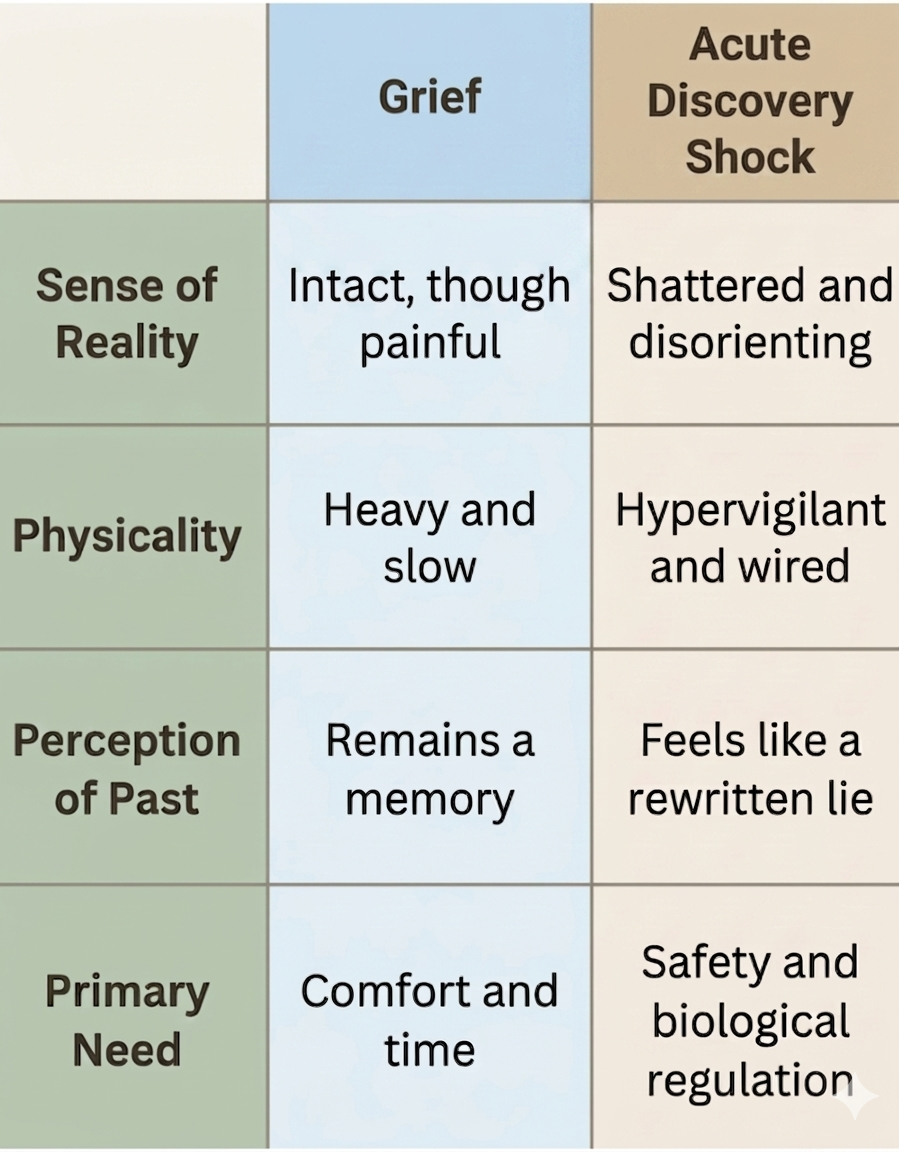
Immediate Steps to Protect Your Peace
When you're spiraling, a concrete list of steps can help anchor your mind. This is about triage, not fixing the marriage.
Prioritize Physical Safety: If the atmosphere in your home feels volatile or unsafe, find a trusted friend or family member to stay with. You cannot process trauma while you're in an active crisis zone.
Manage the Interrogation: It's natural to want to know every detail, but research from Shirley Glass suggests that pacing the information is crucial. Asking for graphic details in the first 24 hours can create mind movies that act as secondary trauma. Focus on the big picture for now so the details can be sorted when you're stabilized.
Implement a Digital Blackout: Avoid the urge to post on social media or look up the other woman. This only fuels the hypervigilance in your nervous system and prevents you from settling.
Hydrate and Regulate: Even if you can't eat a meal, small sips of water and light snacks are necessary. Your brain requires glucose to move out of a panic state and back into a place where you can make basic choices.
Understanding the Trauma of the Secret
It's important to recognize that the trauma of discovery is often more damaging than the infidelity itself. As Michelle Mays discusses in "The Betrayal Bind," the bind occurs because the person you would normally turn to for comfort is now the predator in your environment. The lies, the gaslighting, and the rewritten history of your marriage can make you wonder how he could do this to your family.
This shattered reality is why you feel like you're losing your mind. Your internal recovery is the primary goal, regardless of whether the relationship eventually survives.
Grounding Your Nervous System
To move out of a state of panic, you must bring your awareness back to your physical body. When the mind movies start, your body reacts as if the betrayal is happening again in real-time. Use these somatic tools to interrupt the loop:
Box Breathing: Inhale for four seconds, hold for four, exhale for four, and hold for four. This sends a physical signal to your brain that you're safe and helps lower your heart rate.
Joint Naming: Look at your body and name your joints as you move them. Move your wrist and say, "This is my wrist." Move your elbow and say, "This is my elbow." This forces your brain to reconnect with your physical presence.
Orientation Facts: Speak out loud to the room. Say, "My name is [Name]. I am in my living room. It is Tuesday. I am safe in this moment."
These techniques are essential when you're dealing with intrusive thoughts about the affair, as they pull the brain out of the past and into the present.
Finding the Right Support
Once you've achieved a basic level of stability, the next step is seeking support. Many women instinctively look for marriage counseling immediately after discovery. However, this can be counterproductive and even retraumatizing if the individual trauma hasn't been addressed first. Couples infidelity counselling has real value, but usually later in the process.
There is a distinction between betrayal trauma therapy and couples counseling that’s important to know for your healing. Specialized individual betrayal trauma therapy focuses on your stabilization, your boundaries, and your needs. You need a space where you are the priority, not a space where you're asked to fix a marriage that was just shattered by your husband's choices.
As you move through the 5 stages of healing after betrayal trauma, you'll move from this initial shock into a phase of making sense of what happened. Your focus right now should simply be on maintaining your physical health and basic stability.
A Path Forward
Navigating the collapse of your reality is a heavy burden, but you don't have to carry it alone. At Betrayal Care, we focus on helping wives find their ground and reclaim their sense of self after a husband's infidelity. Our registered therapists provide trauma-informed care for individuals in Alberta, British Columbia, and Ontario who are ready to move toward a place of empowered clarity. If you are in Calgary, you can learn more about our betrayal trauma therapy in Calgary and what your first session looks like. Whether you're in the first 24 hours or the first few months, you deserve a path forward that's defined by your own values and your own timeline. Book a free consultation to speak with a specialist about your next step toward wholeness.
← Back to the Betrayal Recovery Learning Centre to explore more resources.