
How to Stop Thinking About Being Cheated On: Ending the Trauma Loop
← Back to the Betrayal Recovery Learning Centre
When you first discover an affair or a significant betrayal, the world as you knew it ceases to exist. In its place is a relentless internal cinema that plays the same agonizing scenes over and over. You might find yourself staring at a wall for an hour, mentally tracing the timeline of lies, or picturing specific details you wish you didn't know.
If you're wondering how to stop thinking about being cheated on, it's important to first understand that this isn't a sign of weakness or a lack of willpower. It's a biological response to a profound psychological injury. This guide is part of our Betrayal Recovery Learning Centre, designed to help you stabilize and find clarity after discovery.
The intrusive thoughts and mind movies that follow betrayal are exhausting. They steal your sleep, your focus at work, and your ability to feel present in your own life. These thoughts persist because your brain is trying to process a massive amount of data that doesn't fit into your previous reality.
In this article
Why you can't just stop thinking about being cheated on
Dealing with intrusive thoughts after betrayal: The biological why
How to get over the mental images of cheating: Practical interruptions
Stopping the mental replay of the affair through clinical support
Reclaiming your mental space for your own peace
Support for betrayal recovery in Canada
Why you can't just stop thinking about being cheated on
One of the most frustrating parts of betrayal trauma is the feeling that you've lost control over your own mind. Friends or family might tell you to just think about something else, but that advice often feels dismissive. It ignores the fact that your brain has categorized this betrayal as a threat to your survival.
The search for safety in the mental replay
Your brain’s primary job is to keep you safe. When a partner betrays your trust, your internal alarm system, the amygdala, goes into overdrive. It begins to scan every memory and every conversation for clues it might have missed. By replaying the events, your mind is actually trying to find a way to ensure this never happens again. It’s a search for a predictable pattern in a situation that feels completely chaotic.
Understanding mind movies as a trauma response
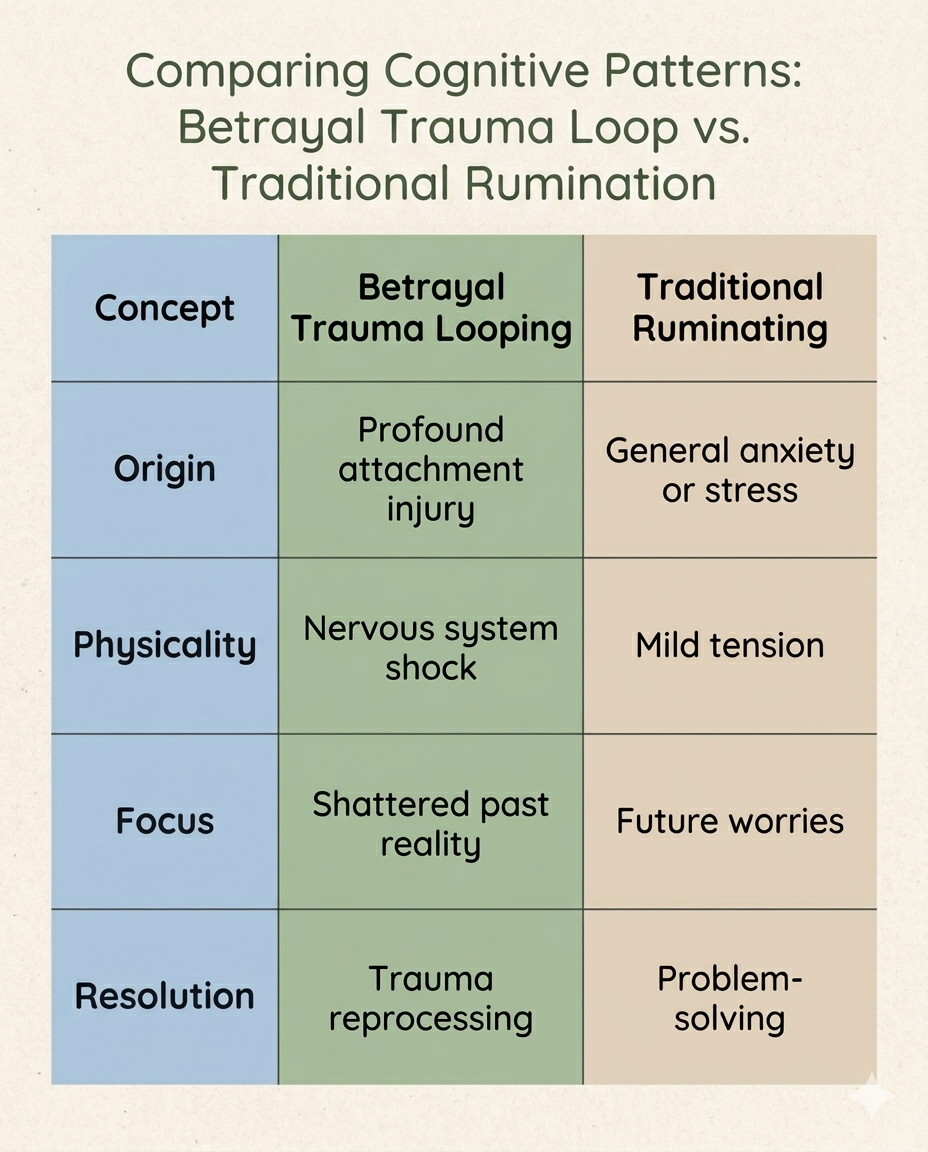
The graphic or repetitive mental images you experience are often referred to as mind movies. These aren't just vivid thoughts. They are intrusive symptoms of trauma. Because the betrayal was a shock to your system, your brain hasn't filed the information away in long-term memory yet. Instead, the information stays active and raw in your working memory, causing it to pop up unbidden at the dinner table, in the shower, or in the middle of the night.

Dealing with intrusive thoughts after betrayal: The biological why
To stop the loop, you have to understand the engine that's driving it. Your nervous system is currently stuck in a state of hypervigilance. You’re likely experiencing a fight or flight response that has nowhere to go, which often manifests as mental spinning. Often, this is a core part of the 5 stages of healing after betrayal trauma, specifically the stabilization and sense-making phases.
Your brain is trying to solve an impossible puzzle
Betrayal creates a massive information gap. You thought your life looked one way, but you discovered it looked another. Your brain hates gaps in logic. It'll replay the affair details, the lies, and the inconsistencies, trying to make the math add up. Dealing with intrusive thoughts after betrayal becomes easier when you recognize that your mind is simply trying to solve an impossible puzzle to regain a sense of mastery over your environment.
The role of hyper-fixation on affair details
It’s common to become obsessed with the who, what, where, and when. You might feel a desperate urge to ask for every detail, believing that knowing everything will finally make the thoughts stop. However, often the more data you collect, the more fuel you give to the mind movies. This hyper-fixation is your brain’s attempt to eliminate the unknown, but it usually results in more intrusive imagery to process.
How to get over the mental images of cheating: Practical interruptions
While you can't simply flip a switch to turn off your thoughts, you can learn to interrupt the loop and lower the intensity of the distress. The goal isn't to forget what happened, but to take the charge out of the images so they no longer overwhelm you when they appear.
Somatic and physical grounding
When you're stuck in a hyper-fixation, your brain is disconnected from your physical reality. These techniques force that connection back.
The 10-To-1 Pressure Trace: Take your thumb and press it firmly into the pad of each finger on the same hand, counting from one to ten. Then, switch hands. Focus entirely on the sensation of the pressure and the texture of your skin. It’s a small, discrete way to interrupt a mind movie while in a public space.
Weighted Gravity Press: If you're sitting or lying down, press your heels as hard as you can into the floor. Feel the resistance of the ground. Imagine the weight of your body being pulled down by gravity, making you stable and unmovable. This helps counter the disorienting sense of detachment that often follows a discovery shock.
The External Focus Scan: Instead of looking for clues in your mind, look for specific textures or patterns outside in the physical world. Count every green object you see. Then, count everything that is soft Then, count that is made of metal or wood. This forces your amygdala to switch from internal scanning to external processing.
Setting boundaries with your own ruminations
You can practice thought containment. When an intrusive thought arises, acknowledge it without judging yourself. You can tell yourself, "I'm experiencing a trauma response. I'll address this for ten minutes later today, but right now I'm focusing on this task." By creating a dedicated time for processing, you begin to train your brain that it doesn't have to be on high alert 24/7.
Stopping the mental replay of the affair through clinical support
Sometimes the hurt is too loud for grounding techniques you can practice by yourself. This is where specialized individual betrayal trauma therapy becomes essential. How to get over the mental images of cheating often involves working with a therapist who understands how to reprocess traumatic memories so they stop looping. Understanding the difference between betrayal trauma therapy and couples counselling is vital. You need individual stabilization to find your own ground before you can effectively determine the future of the relationship. If you both later choose repair, couples infidelity counselling can help you rebuild trust together.
How specialized therapy like ART and EMDR helps
At Betrayal Care, we use specific modalities designed to address the physiological side of betrayal trauma:
Accelerated Resolution Therapy (ART): This uses back-and-forth eye movements to help you change the way traumatic images are stored in your brain. It doesn't make you forget, but it makes the images feel distant and flat rather than vivid and painful.
EMDR (Eye Movement Desensitization and Reprocessing): This helps your brain move the betrayal from active threat to past event, allowing the intrusive thoughts to finally settle.
EFT (Emotion-Focused Therapy) and ACT (Acceptance and Commitment Therapy): These frameworks help you navigate the complex emotions and values associated with the betrayal, providing a roadmap for emotional regulation.
Reclaiming your mental space for your own peace
Therapy isn't just about fixing the problem. It’s about reclaiming your mind. You deserve to have thoughts that aren't centered on someone else's choices. Clinical support provides a safe container to vent the anger and grief so that these emotions don't have to leak out as intrusive thoughts during your workday.
Finding a path forward for your mind and your nervous system
Whether you choose to stay or leave, your primary priority right now is your own stabilization. The mental loops you're experiencing are a normal reaction to an abnormal situation. You aren't broken, and you aren't stuck forever.
By combining grounding tools with professional guidance, you can begin to quiet the noise. You can move from a state of constant hypervigilance to a place of clarity where you can finally decide what's best for you.
Support for betrayal recovery in Canada
If you're struggling to find a moment of peace, specialized therapy can help you interrupt these loops and reclaim your mental space. At Betrayal Care, we provide expert support for individuals across Alberta, British Columbia, and Ontario who are navigating the heavy complexities of infidelity and relational heartbreak. If you live in BC, you can learn more about our betrayal trauma therapy in British Columbia and how virtual sessions can help quiet the loop.
Our team consists of registered therapists in Alberta, British Columbia, and Ontario who specialize in trauma-informed care. Whether you're trying to navigate the aftermath of infidelity or you're struggling with the weight of betrayal trauma, we can help you quiet the noise of hypervigilance so you can find your way back to clarity.
You don't have to navigate this alone. Book a free online consultation to speak with a licensed therapist about how we can help you quiet the loop and find your way back to yourself.
← Back to the Betrayal Recovery Learning Centre to explore more resources.