
How to Start Feeling Like Yourself Again After Betrayal
← Back to the Betrayal Recovery Learning Centre
You know that moment when you catch a glimpse of yourself in the mirror and don't quite recognize the person staring back? That hollow-eyed stranger used to laugh easily, trust their own judgment, and feel solid in their body. If you're reading this after infidelity has torn through your life, you know exactly what I'm talking about. The person you were before the affair can feel like a ghost, while the person you are now can feel fragmented, reactive, and utterly lost.
This sudden disappearance of your former self isn't a failure of character. It's a direct result of your world being fundamentally altered. This guide is part of our Betrayal Recovery Learning Centre, and it's designed to help you stabilize and find clinical clarity after discovery. We're going to explore how to bridge the gap between that "before" version of you and the resilient person you're currently becoming.
In this article
The Science of Identity Loss: Why You Feel Like a Stranger
Step 1: Moving from "The Betrayed" to "The Observer"
Step 2: Rebuilding Trust in Your Own Intuition
Step 3: Somatic Stabilization and Reclaiming Your Body
Step 4: The Integration of Two Realities
The Science of Identity Loss: Why You Feel Like a Stranger
When you experience betrayal, you don't just lose a partner's loyalty. You lose your location in the world. Clinical research into betrayal trauma shows that the "shattering" you feel isn't just emotional distress. It's the collapse of your fundamental assumptions about safety, honesty, and your own intuition.
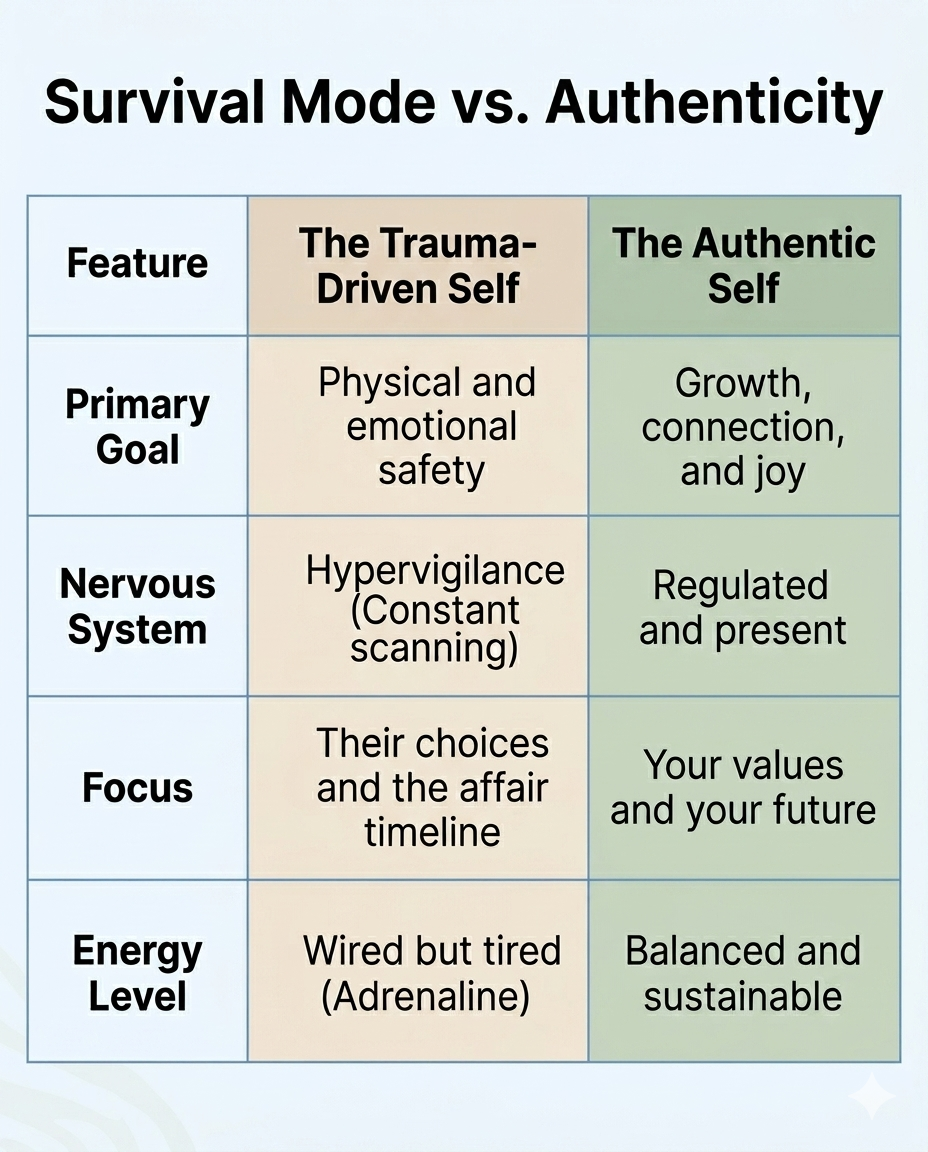
The person you were before discovery existed in a reality where your partner was a "safe harbor." When that person becomes the source of your pain, your brain enters a state of chronic disorientation. If you're wondering how to start feeling like myself again after betrayal, you must first accept that your "old self" isn't gone. It's simply been pushed offline by a survival system that's currently running at 100% capacity.
Betrayal creates a unique psychological injury called an attachment trauma. In a healthy relationship, your partner acts as a mirror, reflecting back a consistent version of who you are. When that mirror is shattered by secrecy, your reflection disappears along with it.
You might feel like you've become a "detective" or a "warden" overnight. You're suddenly monitoring phone logs, tracking locations, and scanning for lies. These behaviors aren't part of your personality. They are symptoms of your nervous system trying to solve an impossible puzzle. Your brain is attempting to reconcile the kind partner you knew with the secretive partner you discovered. Because these two versions don't fit together, your mind loops endlessly to try and find a logic that no longer exists.

Step 1: Moving from "The Betrayed" to "The Observer"
One of the most profound shifts in feeling like yourself again is reclaiming your narrative. Right now, the affair is likely the "main character" of your life. Every conversation and thought circles back to it. To heal, you must move the betrayal from the center of your identity to a chapter in your history.
This starts with a process called differentiation. You are not "the person who was cheated on." You are a whole individual who is currently experiencing a profound attachment injury. When you stop identifying as the trauma and start identifying as the person observing the trauma, you create the breathing room necessary for your personality to resurface. Individual betrayal trauma therapy can help you practise this shift with support.
How to practice differentiation today:
Name the feeling, not the identity: Instead of saying "I am broken," try saying "I am experiencing a wave of grief."
The Five-Minute Anchor: Spend five minutes every morning focusing on a part of your identity that has nothing to do with being a partner. Are you a gardener? A runner? A dedicated professional? Focus on that role exclusively for a few moments.
Audit your Relational Boundaries: Not everyone is equipped to hold the weight of your experience. Practice selective vulnerability by filtering who you share your details with and how much you share. This protects your stabilization process and ensures your narrative is only shared with those who offer genuine safety and support.
Step 2: Rebuilding Trust in Your Own Intuition
The most devastating part of betrayal is the self-gaslighting that follows. You might ask, "How did I not see this?" or "Can I ever trust my gut again?" It's important to understand that your inability to see the deception wasn't a lack of intelligence. It was a sign of your capacity for healthy, secure attachment.
Deception is designed to exploit the very trust that makes a relationship work. You were operating on the rules of a safe reality, while your partner was operating on a secret one. Rebuilding trust in yourself doesn't mean becoming an expert lie detector. It means learning to re-center your own reality.
Understanding how to trust again after being betrayed begins with trusting yourself to handle whatever the truth might be. This is a core part of the 5 stages of healing after betrayal trauma. As you move through the processing phase, your intuition will return as your nervous system settles.
Step 3: Somatic Stabilization and Reclaiming Your Body
Trauma lives in the body. You might notice you're holding your breath, clenching your jaw, or feeling a constant "buzz" in your limbs. This is hypervigilance after cheating manifesting as a physical load. You can't think your way back to your self if your body feels like a crime scene.
Nervous System Stabilization: Use grounding tools to bring your brain back to the present. This signals to your amygdala that the threat of the discovery is in the past, even if the pain is in the present.
Physical Boundaries: Reclaiming your body means setting strict boundaries after infidelity regarding your physical and emotional space. You're allowed to decide who has access to you and under what conditions.
Discharge the Adrenaline: Move your body through walking, stretching, or heavy lifting. This helps your system complete the "stress response cycle" so you don't stay stuck in a loop of discovery shock.
Step 4: The Integration of Two Realities
Feeling like yourself again doesn't mean returning to the person you were before the betrayal. That version of you didn't know this pain was possible. The goal is integration, which is the process of taking this "shattered" reality and weaving it into a new, more resilient version of yourself.
This is a non-linear process. Some days you will feel like your old self, and other days you will feel like you've taken ten steps back. Many people find that betrayal trauma therapy is the key to this stage. You need a dedicated space to work on your integration without the distraction of trying to "fix" the relationship at the same time.
A Path Forward
Navigating this identity crisis is a heavy burden, but you don't have to carry it alone. Working with the best betrayal trauma therapists gives you steady, specialized support while you rebuild. At Betrayal Care, we focus on helping the betrayed partner and find their ground and reclaim their sense of self.
Our registered therapists and psychologists provide trauma-informed care for individuals and couples in Alberta, British Columbia, and Ontario who are ready to move towards a place of empowered clarity. For partners choosing to rebuild together, we also offer couples infidelity counselling. You deserve to feel like yourself again, not just as a survivor, but as a whole person with a future you can trust. Book a free consultation to speak with a specialist about your next step toward wholeness.
← Back to the Betrayal Recovery Learning Centre to explore more resources