
How to Trust Again After Being Cheated On
← Back to the Betrayal Recovery Learning Centre
When you're wondering how to trust again after being cheated on, your mind likely goes straight to your partner. You might find yourself obsessively asking if they will ever be honest or if they're truly capable of change. However, the most agonizing part of betrayal trauma isn't just the loss of trust in them. It is the sudden and terrifying identity disruption that occurs when you realize you can no longer trust your own perception of reality.
Trusting yourself after betrayal is the essential first step in any recovery process. Before you can decide if your relationship is worth saving, you must first believe that you have the internal resources to handle whatever the future holds. This is about moving from a state of being gaslighted into doubting your own sanity to a place of grounded, internal certainty. This guide is part of our Betrayal Recovery Learning Centre, and it will help you shift your focus from their honesty to your own resilience.
In this article
Why Trusting Yourself Feels Impossible Right Now
The Breakdown of Trust: Blind Trust vs. Intuition
Rebuilding Self-Trust After Being Gaslighted
The Betrayal Bind: Why You Seek Comfort from the Person Who Hurt You
Reclaiming Your Sense of Agency and Core Values
Restoring Safety Regardless of the Relationship Outcome
Why Trusting Yourself Feels Impossible Right Now
If you feel like a fool for trusting your partner, you're not alone. It is common to look back at the months or years leading up to discovery and feel like you missed every sign. This often leads to a deep sense of second guessing your perception. You might tell yourself that if you were smarter or more vigilant, you would've known.
In reality, your inability to see the betrayal wasn't a lack of intelligence but was a testament to your capacity for healthy attachment. Experts in affair research explain that betrayal rewrites your history and makes you feel like your entire life was a lie. This loss of reality creates a feeling that your internal compass is permanently broken. When you don't trust your own judgment, you naturally live in a state of waiting for the other shoe to drop.

The Breakdown of Trust: Blind Trust vs. Intuition
Understanding the different ways we trust is vital for your stabilization. You aren't trying to return to a state of naive belief; you're trying to develop a more sophisticated form of self-protection.
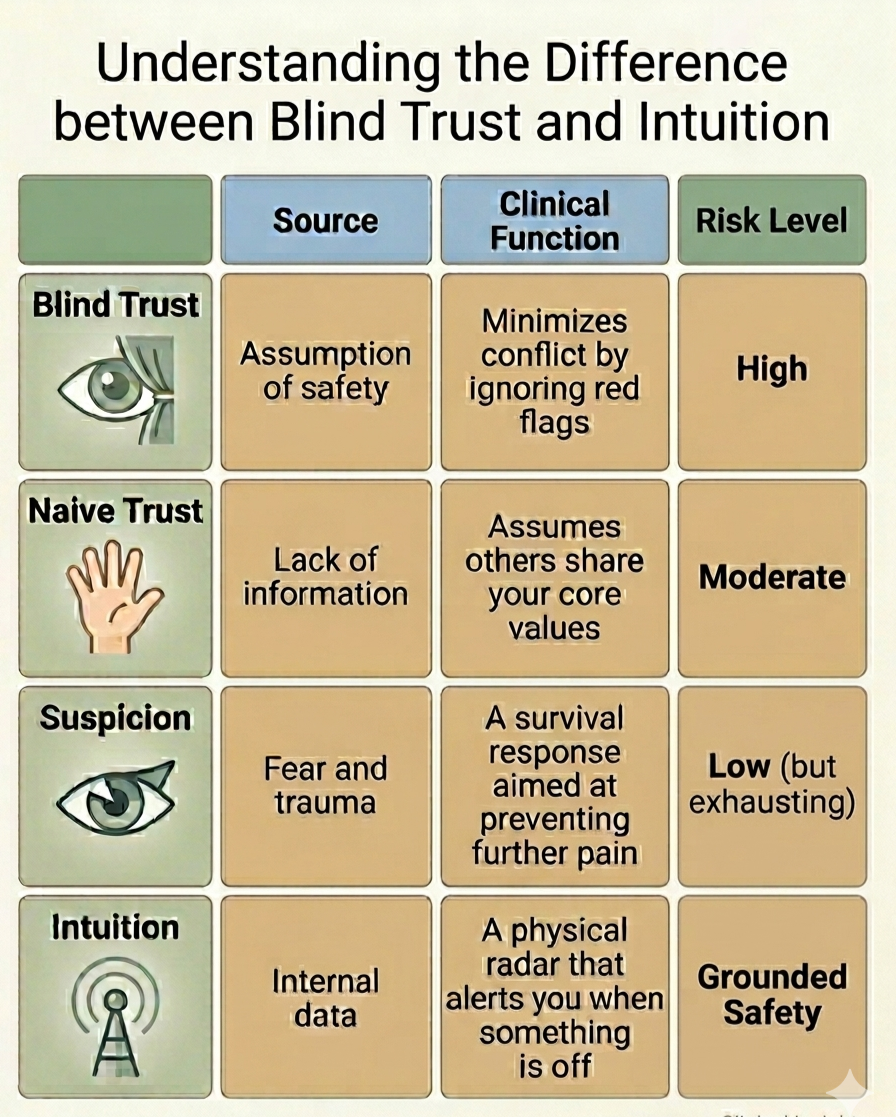
One of the most important tools for discernment and clarity is distinguishing between blind trust and intuition. Blind trust is the assumption that someone will never hurt you, which is often based on a lack of information. Intuition, however, is your internal radar.
After an affair, many people dismiss their gut feelings as paranoia. You might experience physiological bracing, feeling physically tight or on guard at home, and then tell yourself you're overreacting. Trusting your intuition after betrayal means learning to listen to those physical signals again. It is about moving away from the need for absolute certainty from your partner and moving toward a trust in your own ability to notice when something feels off. This is a core part of the 5 stages of healing after betrayal trauma, where you begin to validate your own reality.
Rebuilding Self-Trust After Being Gaslighted
Rebuilding self-trust after a partner has lied about your shared reality requires a clinical approach to re-parenting your own judgment. When you've been gaslighted, your brain has been trained to ignore the truth in front of your eyes. To reverse this, you must begin to validate your own experiences in small, daily ways.
This process involves acknowledging that your feelings, even the intense ones like rage or overwhelming grief, are valid responses to a traumatic event. Clinical specialists note that you're experiencing a normal reaction to an abnormal situation. By consistently honouring your own feelings and observations, you start to repair the connection to yourself that the betrayal severed.
Journal your observations: If you feel something is wrong, write it down. Seeing your observations on paper helps counteract the feeling that you're making things up.
Practice micro-decisions: Trust yourself to choose what you want for dinner or which book to read. These small acts of agency rebuild your confidence in your ability to make choices.
Seek external validation: Work with a specialized therapist who understands the difference between betrayal trauma therapy and couples counselling to ensure your perspective is being grounded in clinical reality rather than the distorted narrative created by the betrayal.
The Betrayal Bind: Why You Seek Comfort from the Person Who Hurt You
Specialists in betrayal trauma describe the biological agony of being pulled toward the person who caused your trauma. This bind is why you might feel a desperate need to have your partner comfort you, only to feel repulsed by them moments later. This emotional whiplash is not a sign of weakness; it is a survival mechanism.
You cannot think your way out of this survival response. If you're experiencing hypervigilance and monitoring, such as constant checking of phones or bank statements, your nervous system is trying to keep you safe. Restoring safety after an affair starts with your body.
Strategies for Nervous System Regulation and Physical Safety:
Joint Naming: Look at your body and name your joints as you move them, saying, "This is my wrist" or "This is my elbow," to force your brain to reconnect with your physical presence.
Boundaries for Emotional Safety: Set boundaries that allow you to feel secure in your own home, such as sleeping in separate rooms or taking a temporary break from discussing the affair.
Biological Triage: Prioritize your physiological needs, including consistent sleep and hydration, to give your brain the fuel it needs to process the trauma.
Orientation Facts: Speak out loud to the room by stating your name, your location, and the current date to pull your brain out of a trauma loop.
Reclaiming Your Sense of Agency and Core Values
Betrayal often makes you feel like a passenger in your own life. Reclaiming your sense of agency means taking back the wheel. This involves reconnecting with your core values. You should ask yourself: "Regardless of what my partner does, what kind of person do I want to be?"
When you focus on your own values, your sense of self is no longer tied to the relationship's success or failure. This creates a foundation stone of stability. Trusting your capacity to handle any outcome is the ultimate form of self-trust. It is the realization that while you cannot control your partner's honesty, you can control your own integrity and your own response. This is essentially the work of start feeling like yourself again after betrayal, shifting your identity away from being a victim.
Restoring Safety Regardless of the Relationship Outcome
Healing is independent of your relationship's future, and you don't need to decide whether to stay or leave today. Provided you're safe from physical danger or domestic abuse, experts recommend a 30-90 day stabilization period before making life-altering choices. If there's any threat of violence or coercive control, your priority must shift immediately from emotional processing to physical safety and relocation planning.
Clarity on your own terms comes when you're no longer operating out of fear. Whether you eventually work on building trust after infidelity as a couple or choose to move forward alone, your internal safety is the priority. When you trust yourself, you know that you will be okay no matter what. You're no longer a victim of the betrayal, but an active participant in your own recovery.
If you're currently struggling with intrusive thoughts, our guide on how to stop thinking about being cheated on offers immediate tools to help you manage the mind movies.
A Path Forward
Navigating the collapse of your reality is a heavy burden, but you don't have to carry it alone. At Betrayal Care, we focus on helping individuals find their ground and reclaim their sense of self after a partner's infidelity. Our registered therapists and psychologists provide trauma-informed care for those in Alberta, British Columbia, and Ontario who are ready to move toward a place of empowered clarity. For readers in Ontario, our infidelity counselling in Mississauga works through exactly this rebuilding process. You deserve to feel like yourself again, not just as a survivor, but as a whole person with a future you can trust. Book a free consultation to speak with a specialist about your next step toward wholeness.
← Back to the Betrayal Recovery Learning Centre to explore more resources.