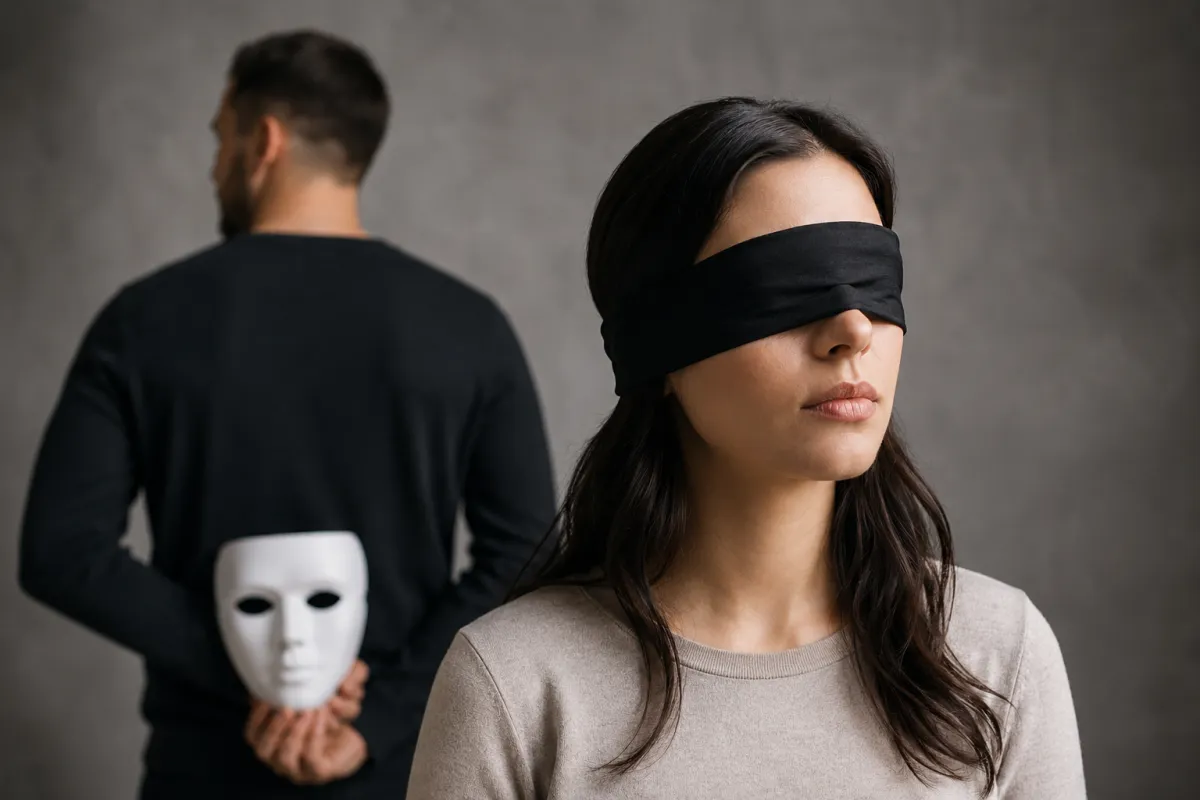
Betrayal Blindness: Why You Couldn't See the Signs
One of the most tormenting questions after a betrayal is not “how could they do this?” It is “how did I not see it?” The late-night messages, the unexplained absences, the gut feeling you talked yourself out of — in hindsight the signs can look so obvious that you start to wonder what is wrong with you for missing them. If you are turning that question over and over, blaming yourself for being naive or willfully ignorant, there is something you need to know: what kept you from seeing was not stupidity, and it was not weakness. It has a name. It is called betrayal blindness, and it is one of the most well-documented and misunderstood responses to betrayal there is.
This article explains what betrayal blindness is, why your brain does it, how to recognize it, and what it means for your healing. Understanding it tends to do something important: it lifts a layer of self-blame that many betrayed people carry for years.
Book a free 15-minute consultation
In this article
What is betrayal blindness?
Why your brain chooses not to see
Betrayal blindness is not denial, and it is not stupidity
Common signs you were (or are) in betrayal blindness
“Knowing and not knowing” at the same time
Where betrayal blindness shows up
Why betrayal blindness makes the aftermath harder
How to move through betrayal blindness and heal
You were not blind. You were protecting yourself.
Frequently asked questions about betrayal blindness
What is betrayal blindness?
Betrayal blindness is the unawareness, forgetting, or not-knowing that people develop in order to preserve a relationship they depend on. The term comes from the psychologist Jennifer Freyd, PhD, who introduced betrayal trauma theory in 1991. Her core insight was deceptively simple: when the person harming you is also the person you rely on for safety, love, or survival, your mind faces an impossible conflict. Seeing the betrayal clearly might mean confronting, withdrawing from, or losing that person — and if you are dependent on them, that loss can feel as threatening as the betrayal itself. So the mind does something protective and strategic: it looks away.
In Freyd’s words, betrayal blindness is the way victims, perpetrators, and even witnesses may remain unaware of betrayal in order to keep relationships, institutions, or social systems intact. It is not that the information is absent. Often, on some level, you knew. It is that knowing fully — letting the truth all the way in — carried a cost your nervous system judged too dangerous to pay at the time.

Why your brain chooses not to see
To understand betrayal blindness, you have to understand how deeply human beings are wired for attachment. From birth, we are built to stay close to the people who keep us safe. A baby who notices every flaw in a caregiver and pulls away would not survive; the ones who stayed bonded, even to imperfect caregivers, are the ones who lived. That same machinery runs in adult romantic relationships, where a partner becomes our primary source of safety and belonging.
Now imagine that the person who is supposed to be your safe harbor is also the source of danger. Detecting the betrayal and acting on it — the normal, healthy response to being harmed — would mean threatening the very bond you depend on. So the brain runs a quiet cost-benefit calculation beneath your awareness, and frequently it concludes that preserving the attachment matters more, in that moment, than registering the threat. The result is betrayal blindness: a kind of motivated unawareness that keeps the relationship, and your sense of stability, intact.
This is why betrayal by someone close cuts so much deeper than harm from a stranger. Research consistently finds that the closer the relationship between the person harmed and the person who caused the harm, the more strongly the trauma predicts symptoms of depression, dissociation, and PTSD (Martin et al., 2013; Goldsmith, Freyd & DePrince, 2012). The same closeness that makes betrayal devastating is exactly what fuels betrayal blindness.
Betrayal blindness is not denial, and it is not stupidity
It is worth being precise here, because the distinction matters for your self-compassion. Denial, in the everyday sense, implies a fairly conscious refusal to accept something you fully grasp. Betrayal blindness is subtler and more automatic. It operates below conscious choice. You are not sitting there deciding to ignore evidence; your attention, your memory, and your interpretation of events are being gently steered away from the threat without your permission. People in betrayal blindness will often explain away the same red flag a dozen different ways, not because they are foolish, but because their mind is doing exactly what it evolved to do under threat to an attachment bond.
This is why the “I should have known” spiral is so misleading. It judges your past self — who was operating inside betrayal blindness, with a brain actively protecting a bond — by the standards of your present self, who now has the full picture. Those are not the same vantage point. You did not fail to see. You were prevented from seeing by a survival mechanism you did not consciously control.
Common signs you were (or are) in betrayal blindness
Betrayal blindness rarely looks like total ignorance. More often it looks like a strange, exhausting split — part of you sensing something is wrong while another part insists everything is fine. Many betrayed partners recognize themselves in several of these patterns:
Chronic explaining-away. Every unsettling detail had a ready reason. The late nights were work stress; the secrecy was a personality quirk; the distance was “just a phase.”
A gut feeling you kept overriding. Your body registered something — a tightness, a dread, a sense that did not add up — and you repeatedly told yourself you were being paranoid or unfair.
Avoiding the obvious next step. You had a passing impulse to look at the phone, ask the direct question, or check the account — and found yourself steering away from it, almost without deciding to.
Memory that blurs. Looking back, whole stretches of time feel hazy, or you struggle to recall details you “should” remember. Betrayal blindness can extend to how the past is stored, not just how the present is perceived.
Minimizing other people’s concern. A friend or family member raised an eyebrow, and you defended your partner or changed the subject — protecting the bond even against outside warnings.
Relief mixed with devastation at discovery. When the truth finally landed, alongside the shock there was a disorienting flicker of relief — the gap between what you sensed and what you let yourself know had finally closed.
If those resonate, you are not describing a personal failing. You are describing the texture of betrayal blindness, which is a recognized response to relational threat.
“Knowing and not knowing” at the same time
One of the most confusing features of betrayal blindness is that it is rarely all-or-nothing. People often live for a long time in a state Freyd and others describe as “knowing and not knowing.” On some level, the information is registered — you feel the wrongness, you notice the inconsistency — but it is kept out of full, integrated awareness, the kind that would force you to act. This is why so many betrayed partners say afterward, “part of me knew the whole time.” Both things were true: a part of you knew, and a part of you genuinely could not afford to know.
This split is also why discovery is so shattering. Betrayal blindness holds two incompatible realities apart so they never have to collide. When the betrayal is finally exposed — a message you cannot unsee, a confession, a discovery — the wall comes down all at once, and everything you sensed but suppressed floods in together. The nervous system experiences this as a sudden, life-sized threat, which is part of why the days after discovery so often feel like genuine trauma rather than ordinary heartbreak.
Book a free 15-minute consultation
Where betrayal blindness shows up
While the term is most associated with infidelity, the same mechanism appears in any relationship where dependency and harm coexist.
In romantic relationships
This is the most familiar form. A partner is having an affair, leading a hidden life, or running up secret debt, and the betrayed partner — precisely because they are so bonded — cannot fully let themselves see it. The deeper the dependence on the relationship for identity, security, or family stability, the stronger the pull toward betrayal blindness.
In childhood
Betrayal blindness was originally studied most in the context of childhood abuse. A child who is harmed by a caregiver cannot leave; they depend on that adult for everything. So the mind protects the bond by blocking awareness, which is one reason abuse by a trusted caregiver is so often minimized, forgotten, or only remembered later. If you grew up this way, you may carry a well-worn capacity for betrayal blindness into adulthood — a learned reflex to look away from harm by people you love.
In families, workplaces, and institutions
The same dynamic scales up. People stay unaware of misconduct in organizations they depend on for income, identity, or belonging, because seeing it clearly would threaten their place within the system. Freyd has written extensively about this institutional version, but for most people reading this, the wound is personal and intimate.
Why betrayal blindness makes the aftermath harder
Here is the cruel twist. The very mechanism that protected you during the relationship can turn against you after discovery. Once the blindness lifts and you see everything you missed, the mind often swings to the opposite extreme: relentless self-interrogation. How did I not know? What is wrong with me? Was I complicit? How can I ever trust my own judgment again?
This is one of the most damaging legacies of betrayal blindness — not the original unawareness, but the self-blame that follows it. It corrodes the one thing you most need to rebuild: trust in your own perception. And because betrayal blindness specifically involved overriding your instincts, many survivors come out of it convinced their instincts are broken, when in fact their instincts were working fine and were simply overruled by a protective system.
Infidelity is also far more common than the silence around it suggests — peer-reviewed research estimates it occurs in roughly one in four marriages (Love and Infidelity: Causes and Consequences, 2023). If betrayal blindness kept you from seeing, you are in very large company, and the unawareness was never a measure of your intelligence.
How to move through betrayal blindness and heal
You cannot simply decide to stop being affected by betrayal blindness, any more than you could have decided to see clearly while it was protecting you. But you can move through it, and the path is more concrete than it feels in the acute days.
Name it accurately. Replacing “I was an idiot” with “I was in betrayal blindness, a known protective response” is not letting yourself off the hook. It is telling yourself the truth, and accurate framing is what loosens the grip of shame.
Stop prosecuting your past self. Your earlier self made sense given what they were protecting. Judging them with information they were actively prevented from holding is neither fair nor useful.
Rebuild trust in your perception slowly. Notice the small instances where your read on a situation turns out to be right. Betrayal blindness damaged your faith in your own instincts; gentle, repeated evidence is how that faith comes back.
Get specialized support. Betrayal blindness is woven tightly into the attachment system, which is exactly where trauma-focused, betrayal-informed therapy does its work. A specialist will not rush you to forgive or reconcile; they will help your nervous system finish the survival response it got stuck inside.
That last point matters more than any tip you can apply alone. Generic talk therapy often misses the specific machinery of betrayal blindness, while a practice that focuses on this exact injury treats it directly. If you want to understand how that work is structured, our main guide on betrayal trauma therapy in Canada walks through the approaches we use and what recovery actually looks like. And if you and your partner are facing the aftermath together, our infidelity counselling for couples addresses the relationship side of that repair.
You were not blind. You were protecting yourself.
If you take one thing from this article, let it be this: betrayal blindness is evidence of how deeply you were bonded and how hard your mind worked to keep you safe — not evidence that you are foolish or that your judgment cannot be trusted. The part of you that “didn’t see” was the same part trying to hold your world together. Now that the truth is in the open, you do not have to make sense of it alone, and you do not have to keep punishing yourself for a mechanism you never consciously chose. If you are in the capital region, our betrayal trauma therapy in Ottawa offers this kind of specialized, betrayal-informed support.
Book a free 15-minute consultation
Keep reading
Betrayal trauma therapy in CanadaOur full guide to specialized betrayal recovery
The 5 stages of healing after betrayal traumaWhat recovery actually looks like
Is betrayal trauma the same as PTSD?The research on PISD and PTSD-level symptoms
EMDR for betrayal trauma: does it work?How EMDR calms intrusive thoughts after infidelity
How to stop thinking about being cheated onGrounding techniques for the trauma loop
How to trust again after being cheated onRebuilding trust in yourself first
Frequently asked questions about betrayal blindness
Is betrayal blindness the same as being in denial?
Not quite. Denial usually implies a more conscious refusal to accept something you fully understand. Betrayal blindness operates below conscious choice — your attention, memory, and interpretation are steered away from the threat automatically, in order to protect a relationship you depend on. That is why it can feel, in hindsight, like you both knew and did not know at the same time.
Does betrayal blindness mean I am partly to blame for what happened?
No. Betrayal blindness is a protective response to betrayal, not consent to it or participation in it. The responsibility for the betrayal belongs entirely to the person who chose to deceive you. Your mind’s effort to preserve the bond was self-protection, not collusion.
Why did part of me seem to know the whole time?
Because betrayal blindness is rarely total. Information is often registered on some level while being kept out of full, integrated awareness — the kind that would force you to act. That “knowing and not knowing” split is a hallmark of the response, and it is also why discovery can feel so overwhelming when the two realities finally collide.
Can betrayal blindness affect memory?
Yes. Freyd’s original work linked betrayal trauma to disruptions in memory, particularly for harm caused by people we depend on. Some survivors find that stretches of the relationship feel hazy, or that details surface only later. This is part of how the mind kept threatening information from being fully integrated.
How do I stop blaming myself for not seeing it sooner?
Self-blame after betrayal blindness is extremely common and extremely treatable. It usually eases through two things: accurate understanding of why the unawareness happened, and specialized therapy that rebuilds trust in your own perception. You are judging a past self who was actively prevented from seeing — and that is a standard no one could meet.
References
Freyd, J. J. Betrayal Trauma Theory — definition. Freyd Dynamics Lab, University of Oregon.
Martin, C. G., et al. (2013). The Role of Cumulative Trauma, Betrayal, and Appraisals in Understanding Trauma Symptomatology. Psychological Trauma.
Goldsmith, R. E., Freyd, J. J., & DePrince, A. P. (2012). Betrayal trauma: associations with psychological and physical symptoms in young adults. Journal of Interpersonal Violence.
Zare, B., et al. (2023). Love and Infidelity: Causes and Consequences. (peer-reviewed review).
Written by Timothy Jon, B.A. Psychology — Clinic Director, Betrayal Care. Tim leads the operational systems and trauma-informed care strategy at Betrayal Care, working to keep our recovery resources practical, accessible, and free of clinical jargon.
Clinically reviewed by Zoe Klein, MSW, BSW, RSW — Registered Social Worker, Ontario.
Betrayal Care is a Canada-wide practice focused exclusively on betrayal trauma, serving clients virtually across British Columbia, Alberta, Saskatchewan, Manitoba, Ontario, and Newfoundland & Labrador, with in-person sessions in Calgary and Toronto.
← Back to the Betrayal Recovery Learning Centre